
Search has shifted from SEO-driven rankings to AI-powered discovery, with users increasingly relying on instant answers from AI tools rather than browsing multiple search results. This shift has introduced concept: Answer Engine Optimization (AEO).
Understanding SEO vs AEO is now critical for businesses that want to stay visible in the digital ecosystem. Traditional SEO still matters, but optimizing content so AI systems can extract and deliver answers is becoming equally important.
This guide explains how AI-powered search functions in SEO. We’ll cover the key differences between SEO and AEO. We’ll also show how businesses can update their websites for the future of search.
Search is shifting from short keywords to intent-rich questions. AI uses trusted, structured content to answer directly, so businesses should prioritize content that addresses real user questions, not just rankings.
What Is SEO?
Search Engine Optimization (SEO) is the process of improving a website. It helps the site appear higher in regular search results. The goal is simple: when someone searches for a relevant topic, your website should appear among the top results.
For years, SEO has been the foundation of digital marketing strategies. Businesses spend a lot of time and money improving their websites.
This helps them appear in search engines like
SEO works by aligning your website with the ranking factors used by search engines. These factors evaluate content quality, technical performance, and overall authority.
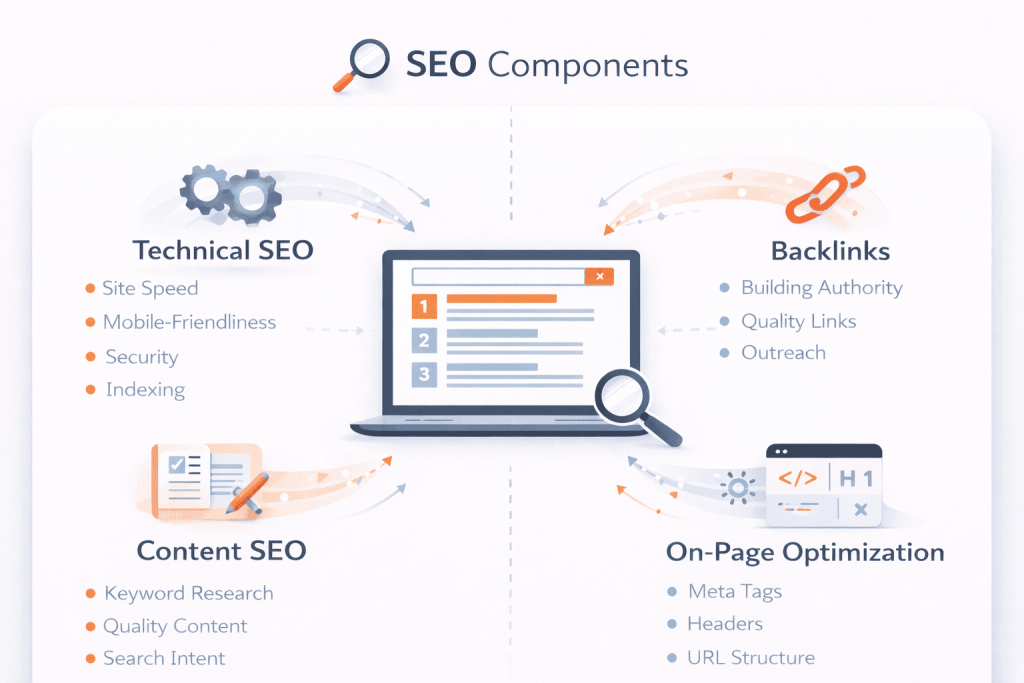
While SEO involves many technical details, marketers generally divide it into four major areas.
On-Page SEO
On-page SEO focuses on optimizing individual pages of a website. This includes writing content that targets specific keywords. It also ensures the page structure is easy for search engines to understand.
Important on-page elements include:
- Optimized titles and meta descriptions
- Clear heading structure (H1, H2, H3)
- Keyword placement within content
- Internal linking between related pages
- Optimized images and media
When done right, on-page SEO helps search engines understand a page. It also indicates how closely it matches the user’s search query.
Technical SEO
Technical SEO ensures that search engines can efficiently crawl and index a website. Even high-quality content may struggle to rank if technical issues prevent search engines from understanding the site.
Key technical factors include website speed, mobile responsiveness, structured data implementation, and proper site architecture.
Many businesses rely on professional development teams to improve technical SEO through services such as custom development solutions.
Off-Page SEO
Off-page SEO refers to signals that occur outside the website but influence its authority. Search engines interpret backlinks from other websites as endorsements of trust and credibility.
Examples of off-page SEO include:
- Backlinks from reputable websites
- Brand mentions online
- Digital PR campaigns
- Social media visibility
The stronger your backlink profile, the more trustworthy your website appears to search engines.
Marketers often rely on SEO tools to improve website performance and monitor rankings. Platforms like Google Search Console help businesses track search performance, review search queries, and find ways to improve content.
SEO tools can help you discover opportunities to appear in featured snippet rankings. A featured snippet appears at the top of search results. These snippets provide quick answers to users and can significantly increase visibility for websites that structure their content clearly.
Content SEO
Content remains one of the most powerful elements of SEO. Informative blog posts, guides, and resources help websites rank for relevant search queries while delivering value to readers.
However, traditional SEO focuses primarily on ranking webpages, not necessarily on providing direct answers. This is where the concept of AEO begins to emerge.
What Is AEO (Answer Engine Optimization)?
Answer Engine Optimization, or AEO, is the process of structuring content for AI systems.
It helps them extract the content and present it as a direct answer to a user’s question. Unlike traditional SEO, which ranks pages in search results, AEO makes your content useful for AI assistants. It also helps generative search systems use your content.
These systems include platforms like AI chat assistants, voice search tools, and generative search features. These features summarize information from multiple sources. Instead of presenting a list of websites, AI systems analyze data across the web and generate a concise answer.
To do this effectively, they rely on content that is:
- Well structured
- Authoritative
- Easy to interpret
- Organized around clear questions and answers
Modern generative AI systems analyze massive amounts of data across the web. These systems use generative AI models to understand context, extract key points, and create content. They respond to user queries immediately. Because of this technology, websites must focus on clarity, authority, and structured information.
This shift means websites must think beyond rankings and focus on being the source used to generate answers.
Why AI Search Is Transforming Website Optimization
Artificial intelligence is rapidly changing how people search for information online. Several major trends are driving this transformation.
To begin, users more often demand immediate answers. Traditional search requires users to click through multiple results to find the information they need. AI-powered tools eliminate this step by generating answers immediately.
Second, search is becoming more conversational. Instead of typing short keywords, users now ask complete questions such as:
- “What is the difference between SEO and AEO?”
- “How should businesses optimize for AI search?”
Designers create AI systems to understand these natural language queries.
Third, voice-based searching is expanding quickly. Voice assistants typically deliver a single spoken answer rather than a list of links. This makes structured and authoritative content even more important.
Together, these trends are reshaping how websites must approach optimization.
SEO vs AEO: Key Differences
Understanding the relationship between SEO vs AEO requires examining how their goals differ.
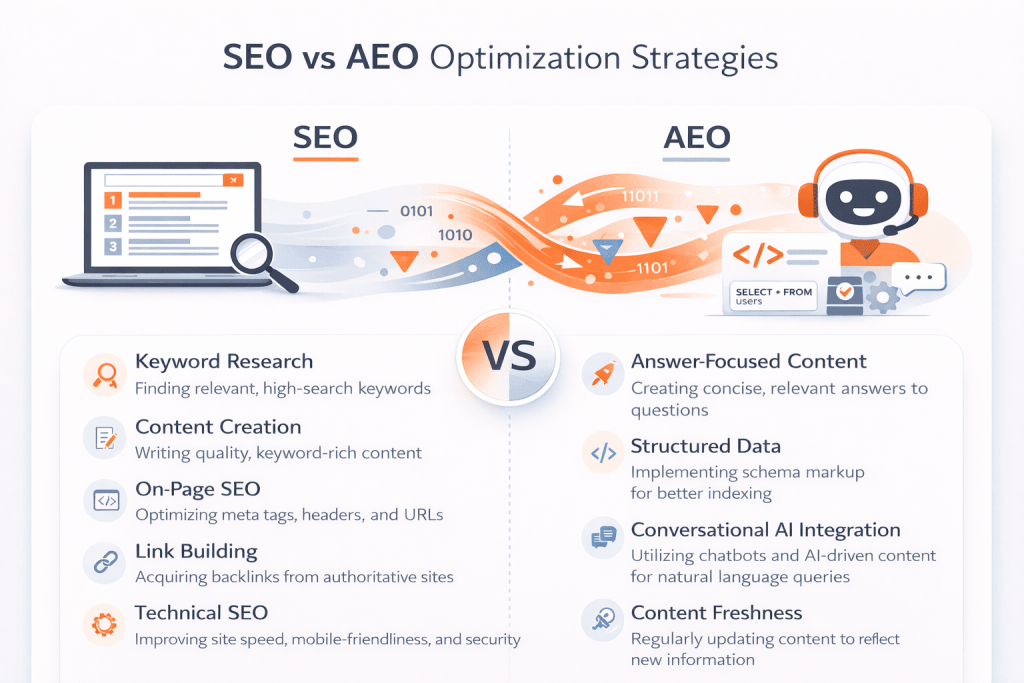
Traditional SEO focuses primarily on ranking webpages in search engine results. We measure success using metrics such as keyword rankings, organic traffic, and click-through rates.
AEO, on the other hand, focuses on providing clear, concise answers that AI systems can use directly. Rather than ranking in the top ten search results, the goal is to become the source AI responses cite.
Several core differences highlight how these strategies work.
SEO emphasizes:
- Keyword targeting
- Backlinks and authority
- Page rankings
- Organic traffic growth
AEO emphasizes:
- Structured information
- Question-based content
- Semantic clarity
- Authoritative answers
Although these strategies differ, they are not mutually exclusive. In fact, the most effective modern strategies combine both SEO and AEO principles.
How AI Search Engines Work
AI-powered search engines use advanced machine learning models to interpret and summarize information across the internet. These systems analyze content in ways that go beyond simple keyword matching.
Instead, they focus on understanding the meaning, context, and credibility of information.
When a user asks a question, AI search engines typically perform several steps.
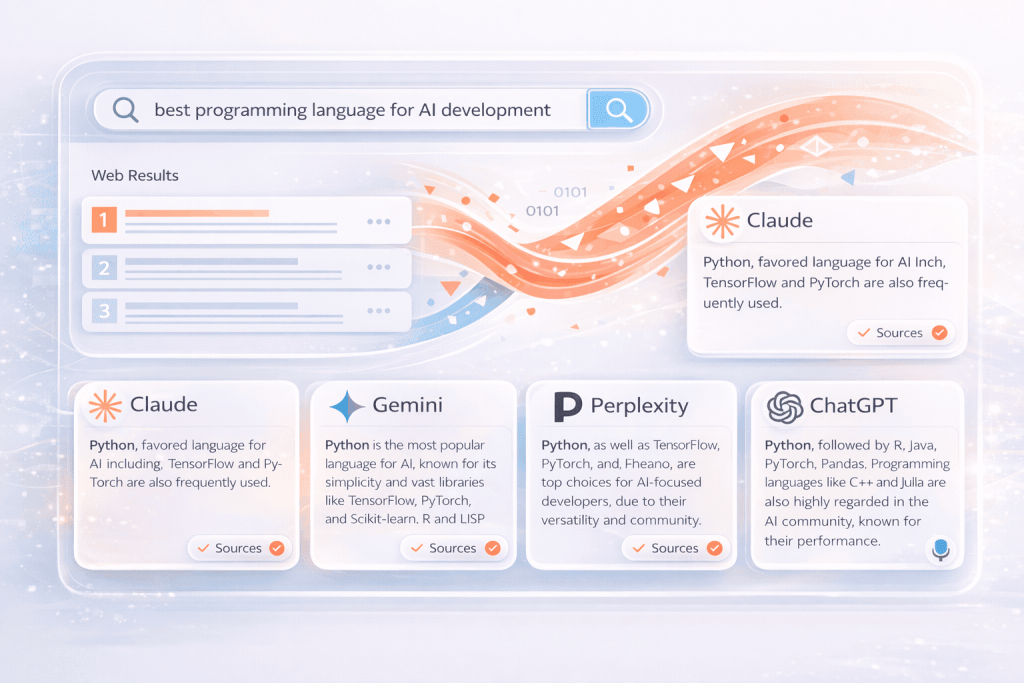
First, the system scans multiple sources across the web to identify relevant information. Clearly structured, authoritative pages are more likely to get selected. Next, the AI model extracts key points from those sources. It looks for concise explanations, definitions, and structured sections that directly answer the user’s query.
Finally, the AI synthesizes the information into a single response. Some systems may also cite the sources used to generate the answer. Because of this process, people reference websites more often when they present information clearly and logically.
Why Businesses Must Adapt to AEO
Businesses that ignore AI-driven search risk losing visibility as user behavior continues to evolve.
AI-powered search experiences are expanding rapidly across search engines, chat assistants, and voice devices. As these systems become more popular, users may interact with search results differently than before.
Another major shift is the rise of zero-click searches. These occur when users receive the answer directly within the search interface and never visit a website.
Although this may reduce some traffic, it also creates new opportunities. Websites that become trusted sources for AI-generated answers can gain significant brand visibility and authority.
Companies that adapt early will have a competitive advantage in this emerging ecosystem.
Optimizing Websites for Both SEO and AEO
Rather than replacing SEO, AEO should be viewed as an extension of traditional optimization strategies. The most successful websites optimize their content for both search engines and AI systems.
1- Create High-Quality Structured Content
One of the most effective strategies is creating structured content. Well-organized pages with :
- Clear headings
- Short paragraphs
- Logical formatting
This improves readability for both humans and AI.
2- Use Question-Based Headings
AEO content often answers questions.
Examples include:
- What is SEO vs AEO?
- How does AI search work?
- Why is AI optimization important?
Implement Structured Data
Schema markup helps AI understand website content.
Examples include:
- FAQ schema
- Article schema
- HowTo schema
Structured data improves visibility in AI-generated answers.
Improve Website Performance
Fast websites are favored by both search engines and AI systems.
Businesses should focus on:
- Page speed
- Clean code
- Optimized images
- Server performance
Businesses often implement these improvements through professional SEO services.
The Role of Website Design in AI Optimization
Website structure and user experience play a major role in how easily search engines and AI systems interpret content.
Poor navigation, cluttered layouts, and slow loading speeds make it hard for users and search engines to find information. A well-designed website should guide users logically through content while making key information easy to find. Modern redesign projects often focus on improving:
- Better content structure
- Optimized navigation
- Faster page performance
- Improved mobile UX
These improvements enhance both SEO and AEO performance. Businesses looking to modernize their online presence often invest in professional redesign solutions.
Why WordPress Is Ideal for AI-Friendly Optimization
WordPress remains one of the most powerful platforms for modern website optimization. Its flexibility allows developers to implement both SEO and AEO strategies effectively.
The platform supports a wide range of plugins and tools that help businesses improve their search visibility.
Key advantages include:
- Advanced SEO plugins like RankMath or Yoast
- Built-in content management flexibility
- Easy integration of structured data
- Scalable website architecture
Professional development teams often customize WordPress websites to ensure optimal performance and search visibility. This activates optimize your content, optimizing content, internally linking.
To succeed in modern search environments, businesses must continuously optimize their content. This includes improving headings, updating old information, and linking related pages within the site. This helps search engines understand the website’s structure better. Proper internal linking also helps guide users to relevant blog posts and resources.
Businesses looking for tailored solutions often rely on professional development services.
Elementor and Modern SEO Design
Page builders such as Elementor make it easier to create visually engaging websites without sacrificing SEO performance.
With proper development practices, Elementor-based websites can maintain clean code structures while delivering modern design experiences.
Optimized Elementor websites support:
- Responsive design across devices
- Structured page layouts
- Faster loading times
- Improved user engagement
Businesses seeking advanced customization often work with professional Elementor developers.
Common Mistakes Businesses
Make Many businesses misunderstand the relationship between SEO vs AEO. Common mistakes include:
1- Ignoring AI
Search Some companies assume AI search is a trend. In reality, it is becoming the dominant discovery method.
2- Overusing Keywords
AI systems prioritize context and clarity over keyword stuffing.
3- Poor Content Structure
Large blocks of text reduce the likelihood of being used as an answer source.
4- Weak Website Performance
Slow websites reduce both search rankings and AI credibility.
The Future of Search: SEO and AEO
Working Together The future of search will likely combine traditional ranking systems with AI-generated answers.
Search engines are already integrating generative AI features that summarize information directly within search results. This means websites must provide content that works well for:
- Rankings
- AI extraction
- Voice search
- Conversational queries
Businesses that invest in both SEO and AEO strategies will be better positioned to adapt to these evolving technologies.
By combining structured content, authoritative information, and strong technical optimization, companies can maintain visibility regardless of how search platforms evolve.
Conclusion: SEO vs AEO Is the Next Evolution of Search
The debate around SEO vs AEO is not about replacing traditional optimization strategies. Instead, it reflects the natural evolution of how people access information online.
SEO continues to drive organic traffic and remains a critical part of digital marketing. At the same time, AEO helps AI systems find content and deliver it as direct answers. Businesses that combine both strategies will be best prepared for the future of search.
As search technology evolves, businesses must use new strategies that mix traditional SEO with AI-based methods. People can also share content that ranks well in search engines on social media platforms. This helps brands reach more people. It also keeps them visible in search engines and AI systems.
At Coresol Studio, we help companies build modern websites. They perform well in search engines and new AI search platforms. Our services include:
- Custom WordPress development
- UI/UX Development
- Plugin & Feature Customization
- SEO optimization strategies
To keep your website competitive in the age of AI search, choose the right team. A strong development and optimization partner can make a significant difference.